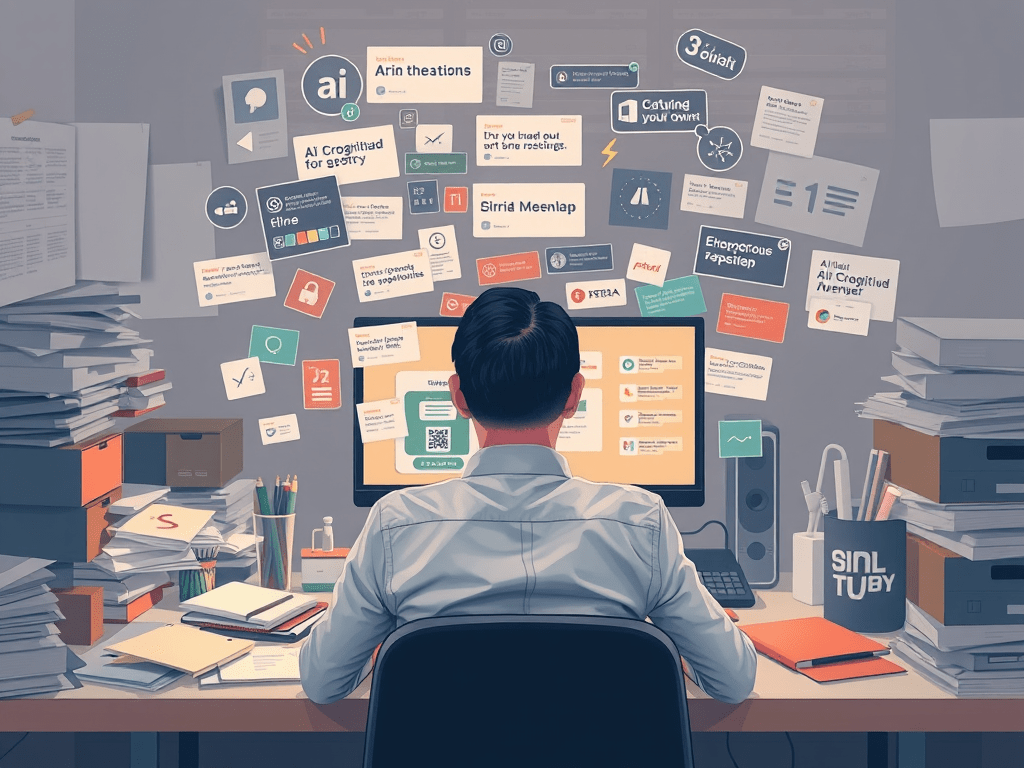
In the last two years, AI copilots have exploded across enterprises. Every tool promises an assistant. Every workflow claims to be AI-powered. Yet quietly, something else is happening.
People are tired.
Not tired of AI itself, but tired of interacting with it. Too many prompts. Too many side panels. Too many suggestions that interrupt rather than help.
This is the copilot paradox. AI is more capable than ever, but its usability at work is declining. In 2026, the next wave of AI will not talk more. It will talk less.
What Is AI Copilot Fatigue?
AI copilot fatigue shows up in subtle ways:
- Employees stop opening the AI panel.
- Suggestions are ignored by default.
- Leaders question why productivity gains plateau.
The problem is not model quality. It’s interaction cost.
Every copilot asks users to:
- Switch context.
- Review suggestions.
- Decide whether to trust them.
- Correct or restate intent.
Over time, this becomes cognitive overhead. AI that was meant to reduce effort ends up adding friction.
Why Enterprises Are Seeing Diminishing Returns
Early AI pilots focused on visibility. Leaders wanted to see AI in action. Dashboards, chat windows, prompts, explanations.
But scale changes the equation.
At enterprise scale:
- Repeated prompts slow work.
- Compliance teams add guardrails.
- Training costs rise.
- Productivity gains flatten.
AI adoption stalls not because AI fails, but because humans don’t want to babysit it.
The Shift Toward Invisible AI
The next phase of AI is already emerging. It’s quieter and more effective.
Invisible AI works like this:
- No chat window.
- No prompt.
- No decision required.
Instead:
- Reports are already summarized.
- Data pipelines auto-fix anomalies.
- Forecasts adjust silently within guardrails.
- Workflows complete without interruption.
The user notices the outcome, not the AI.
This mirrors how successful technology always scales. Nobody thinks about TCP/IP while browsing the web. AI is moving in the same direction.
Agentic AI Without the Noise
Agentic AI is often discussed as autonomous systems that plan and act. But autonomy does not require conversation.
The most effective agents in 2026:
- Operate within bounded workflows.
- Trigger actions based on signals.
- Escalate only when confidence drops.
Instead of asking, “What should I do?”, the system acts and informs only when necessary.
This is trust-based AI, not prompt-based AI.
What This Means for Leaders and Builders
If you are designing AI solutions today, ask these questions:
- Can this run without user input?
- Does this reduce decisions or create new ones?
- Will users notice if it works well?
If the AI requires constant attention, it will fail at scale.
Winning AI products in 2026 will be judged on:
- Reduced friction.
- Fewer interactions.
- Measurable time saved without retraining users.
The Real KPI for AI in 2026
The most important AI metric is no longer accuracy or latency.
It’s this:
How often does the user forget the AI exists?
When AI becomes invisible, adoption becomes natural. Resistance disappears. Value compounds quietly.
The future of AI at work is not louder copilots or smarter chat windows. It’s systems that understand context, act responsibly, and stay out of the way.
The best AI does not ask for attention.
It earns trust by delivering results.
 SappersAI
Leave a comment